Daily Schedule Journal: Your Blueprint for Productive Days
Imagine closing a workday, or any day, with a clear sense of accomplishment. You know exactly what you focused on, what you completed, and where your time went. This isn't about vague resolutions; it's about concrete tracking. A Daily Schedule Journal is the tool that makes this possible. More than a simple notebook, it's a structured log designed to record your work hours, rest periods, activities, and follow-ups—essentially, the architecture of your day. For many successful individuals, this practice isn't just a habit; it's a foundational system.
The core idea is deceptively simple: observation precedes improvement. You cannot reliably optimize what you do not measure. By consistently logging your schedule, you move from operating on intuition to managing with data. This isn't solely for corporate CEOs. Whether you're a freelancer juggling multiple clients, a creator balancing art with admin, or a student managing coursework and personal projects, a dedicated daily log provides the clarity needed to navigate competing priorities.
What Makes This Tool Stand Out
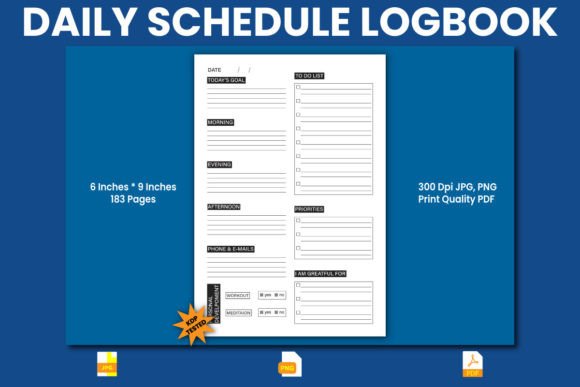
While any notebook can serve as a log, a purpose-built Daily Schedule Journal offers structure that eliminates guesswork. Its design includes columns for specific points of data: task, time allocation, priority status, and follow-up actions. This columnar format forces a helpful brevity and consistency, turning daily entries into a comparable dataset over weeks and months.
Consider the physical specifications: a 6-inch by 9-inch format strikes a balance between portability and ample writing space. With 183 pages, it commits to being a long-term companion, not a fleeting experiment. The availability of high-quality PDF, 300 dpi JPG, and PNG files speaks to its versatility. This digital adaptability means you can use the framework in printed form, digitally on tablets, or even integrate its layout into digital planning apps, blending analog discipline with digital convenience.
Beyond Time Tracking: The Multidimensional Benefits
The immediate benefit is obvious—you know where your time goes. But the real value unfolds in secondary effects. A meticulously maintained Daily Schedule Journal becomes a powerful communication tool. For teams or clients, a summarized log can transparently show project focus and investment. It builds trust through accountability. For the individual, it reduces mental clutter. The act of writing down tasks and schedules externalizes them, freeing your mind from the constant work of remembering and reminding.
This practice also enhances self-negotiation. When you see, in black and white, that you scheduled only 30 minutes for a task that consistently takes two hours, you stop arguing with reality. You adjust. It provides undeniable evidence for your work patterns, helping you set realistic goals and defend your need for focused blocks of time or genuine rest periods.
Real-World Applications Across Fields
The utility of a Daily Schedule Journal transcends job titles. Let’s explore a few scenarios.
For the Entrepreneur or Freelancer: Client work, business development, administrative tasks, and personal learning often collide. Using the journal’s columns, you can assign time not just to what you did, but to which client or business area it served. This makes invoicing, project assessment, and capacity planning far more accurate. You might discover that certain "quick" emails are consuming a disproportionate part of your week, prompting a process change.
For Creatives & Hobbyists: Creative work can feel intangible and hard to schedule. A log shifts the focus from output (which can be variable) to input—the dedicated time spent sketching, writing, practicing, or researching. This protects the creative process from being drowned by other obligations. By logging "rest hours," you also honor the necessary downtime that fuels inspiration, making it a scheduled part of your craft, not an accident.
For Educators & Marketers: These roles are often a mosaic of teaching, content creation, communication, and analysis. A daily log helps compartmentalize these different modes. A teacher might track hours spent on lesson planning, grading, and student conferences. A marketer might log time dedicated to campaign design, analytics review, and community engagement. This data is invaluable for reporting to stakeholders or simply for personal efficiency audits.
Practical Considerations for Implementation
Starting with a Daily Schedule Journal requires a bit of intention. First, commit to consistency, not perfection. An entry doesn't need to be exhaustive; even a partial log provides more insight than none. The key is making it a daily ritual, perhaps at the day's end or as a morning plan.
Customize the columns to your needs. While the provided structure is excellent, the "appropriate points" columns are your canvas. You might add a column for "Energy Level" to track productivity against your biological rhythms, or "Outcome" to briefly note if a task was completed, deferred, or abandoned. The tool serves you; adapt it.
When evaluating digital use, the high-resolution image files (JPG, PNG) are perfect for importing into note-taking apps like GoodNotes or as templates in graphic software. The PDF is ideal for printing or for use in PDF annotation apps. This flexibility ensures you can maintain the practice whether you prefer pen and paper or a digital tablet.
Finally, review your logs periodically. Set a monthly or quarterly review. Look for patterns: Are certain tasks always overflowing their time boxes? Are your "rest hours" consistently skipped? This review is where the journal transforms from a record into a strategic planning document. It informs your next month's schedule, helping you allocate time more realistically and protect your priorities.
The Cumulative Power of Daily Documentation
A Daily Schedule Journal is, in essence, a contract with yourself. It’s a commitment to pay attention to how you spend your most finite resource: time. Over weeks, the pages build a portrait of your working life—your strengths, your distractions, your rhythms. This isn't about rigid control; it's about informed agency. You begin to design your days based on evidence, not wishful thinking.
For anyone feeling the friction of fragmented focus or the ambiguity of unstructured work, this tool offers a path to clarity. It provides the framework to not just be busy, but to be effective. By tracking not only work but mandated rest, it supports a holistic approach to productivity that sustains energy and prevents burnout. In a world of constant demand, your Daily Schedule Journal becomes your anchor, your record, and your guide. God bless your journey toward more intentional and successful days.