Understanding the Medical SOAP Notebook: A Tool for Precision and Organization
In the fast-paced world of healthcare, clarity and organization are not just administrative niceties—they are essential components of effective patient care and professional practice. For students, clinicians, and private practitioners, the challenge of documenting complex information consistently and accurately is a daily reality. Enter the Medical SOAP Notebook, a specialized tool designed to bring order to this critical process. Far from being a simple blank journal, it is a structured system built around the proven SOAP framework, transforming progress notes from scattered observations into coherent, actionable records.
The SOAP Method: A Foundation for Clinical Reasoning
Before exploring the notebook itself, it’s important to understand the methodology it embodies. SOAP stands for Subjective, Objective, Assessment, and Plan. This four-part format is a cornerstone of clinical documentation across numerous medical disciplines.
- Subjective: This section captures the patient’s own story—their symptoms, concerns, and personal history. It includes everything the patient reports, from "I’ve had a headache for three days" to their description of past medical events.
- Objective: Here, the clinician records measurable, observable data. This includes vital signs, physical exam findings, laboratory results, and imaging reports. It is the factual, verifiable evidence gathered during the encounter.
- Assessment: This is the synthesis of the subjective and objective information. It involves the clinician’s analysis, differential diagnoses, and clinical judgment, weaving the data into a coherent understanding of the patient’s condition.
- Plan: The final section outlines the course of action. It details the proposed treatment, further tests needed, medications prescribed, patient education provided, and follow-up arrangements. It is the roadmap forward.
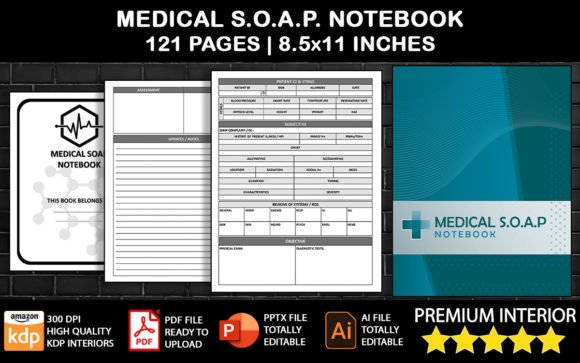
The Medical SOAP Notebook provides a dedicated template for this framework on every page, guiding the user to document each encounter with this logical, standardized flow.
Who Benefits from a Medical SOAP Notebook?
The utility of this tool extends far beyond a single role or setting. Its structured approach serves a wide spectrum of healthcare professionals and learners.
- Medical Students: Learning to think and document clinically is a core skill. Using a Medical SOAP Notebook during rotations helps students internalize the SOAP format, turning theoretical knowledge into practical habit.
- Residents: During busy residency years, efficiency and accuracy are paramount. The notebook offers a consistent place to draft and organize progress notes before formal electronic entry, ensuring no critical detail is lost in the rush.
- Clinical Practitioners (NPs, PAs, MDs, DOs): In clinic or hospital settings, having a reliable physical or printable template for quick notes, especially during complex cases or for personal reference, can complement digital systems.
- Private Practice Owners: For practitioners managing their own offices, the notebook can serve as an excellent backup system, a tool for initial encounter sketches, or a structured log for specific projects or patient cohorts.
- Other Healthcare Disciplines: The SOAP format is also used in physical therapy, occupational therapy, nursing, and psychiatry. Professionals in these fields can adapt the Medical SOAP Notebook to their specific documentation needs.
Features and Practical Design of the Notebook
A typical Medical SOAP Notebook is designed with the user’s practical workflow in mind. The interior consists of 121 pages of blank SOAP templates, each clearly labeled with the four sections. The trim size of 8.5×11 inches provides ample space for detailed writing without being cumbersome, and the "no bleed" design means the pages are clean and ready for use. The high-quality resolution ensures the template is sharp and easy to read.
The true value lies in its adaptability. The notebook is not a rigid, pre-bound book you purchase off a shelf. Instead, it is provided as a set of digital files—a PDF ready for upload to a print service or for direct printing, and an editable PPT file. This means you can add or delete pages as needed, customizing the length to your specific rotation, residency block, or clinical term. The cover files, including editable AI and EPS formats, allow for further personalization, enabling a practice or institution to add its logo or name.
This digital-first approach makes the Medical SOAP Notebook a versatile resource. You can print a copy for your current semester, create a bound volume for your entire residency, or generate specific pages for a particular clinic. Files tested in KDP Previewer ensure compatibility if you choose to use print-on-demand services.
Real-World Applications and Scenarios
How does this tool translate from concept to daily use? Consider a medical student on their internal medicine rotation. During a morning round, they encounter a patient with new-onset abdominal pain. Using their Medical SOAP Notebook, they quickly jot down the patient’s subjective description (S). After the exam, they record the objective findings: temperature, abdominal tenderness, relevant lab values (O). During their lunch break, they reflect, formulating a preliminary assessment considering possibilities like gastroenteritis or appendicitis (A). Finally, they note the plan discussed with the attending: continue observation, schedule an ultrasound, start antibiotics (P). This single page now holds a complete, organized clinical snapshot for study, reference, or formal note transcription.
For a nurse practitioner in a busy family practice, the notebook might serve as a quick-capture tool between patients. While electronic health records are ultimate, the physical template can be faster for capturing the initial flow of information during the visit, ensuring the later digital entry is thorough and structured.
Evaluating Its Suitability: Strengths and Considerations
The Medical SOAP Notebook excels in providing structure and promoting disciplined clinical thinking. Its primary strength is its focus on the gold-standard SOAP format, actively training and reinforcing a critical professional skill. The editable, printable nature offers great flexibility and cost-effectiveness compared to pre-made, generic notebooks.
Some considerations are worth noting. The tool is a template—it provides the framework, but the quality of the content depends entirely on the user’s knowledge and diligence. It is also a physical or printed product, which may not integrate directly with mandatory digital record systems in many modern settings. Its best use is often as a complementary tool for learning, drafting, or personal organization, rather than a sole official record. For individuals who thrive with unstructured note-taking or who work exclusively in fully digital environments, its value may be less pronounced.
Guidance for Different Needs and Projects
When deciding if a Medical SOAP Notebook is right for you, consider your primary goal.
- For Learning and Training: If you are a student or new graduate, this notebook is highly recommended. The repetitive use of the template builds muscle memory for clinical documentation.
- For Efficiency in High-Volume Practice: If you find yourself forgetting details before entering them into an EHR, using the notebook as a quick draft pad can improve accuracy and completeness.
- For Custom Projects: If you are conducting research, tracking a specific patient group, or developing a new clinic protocol, the editable templates allow you to create a tailored documentation log for that specific purpose.
- For Teams or Institutions: The editable cover and interior files make it possible to create a standardized, branded notebook for an entire residency program or clinical team, fostering a uniform approach to note-taking.
Ultimately, the Medical SOAP Notebook is more than just paper. It is a practical embodiment of a fundamental clinical method. By externalizing the SOAP structure, it supports healthcare professionals in their mission to document clearly, assess accurately, and plan effectively—one organized page at a time.